People use the app
Forms, queues, tables, detail pages, and command actions are rendered from the Blueprint.
Define data, commands, workflows, permissions, and UX in one Blueprint. Zebric gives people a working web app and gives agents a governed MCP interface to the same application model—without putting an LLM in the runtime path.
A Zebric app does not need a separate “AI layer.” The runtime publishes an Agent API from the same Blueprint that renders the human interface. The MCP adapter turns approved operations into tools, while Zebric keeps its authorization, validation, idempotency, workflow, and audit rules in charge.
See the agent architectureForms, queues, tables, detail pages, and command actions are rendered from the Blueprint.
Read tools are discoverable by default. Mutations require explicit operation-level approval.
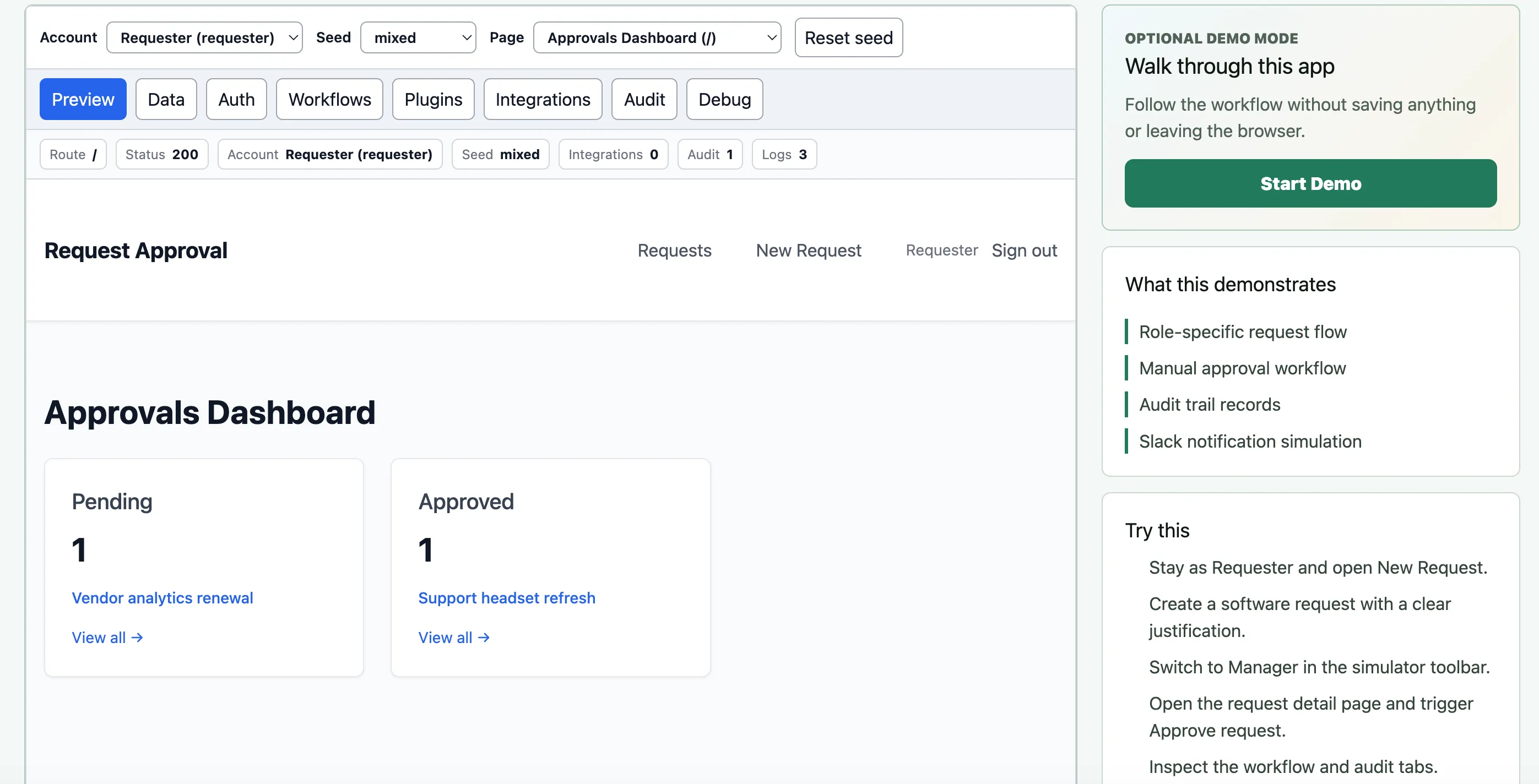
On the left: the model your team can review and version. On the right: the forms, tables, workflow states, and permissions Zebric renders from it.
The approval tracker someone built in 2021 is now load-bearing. Nobody owns it, everybody depends on it.
Every team buys a tool; every handoff between them is a Zap, a script, or a person copying rows on Friday.
The custom admin panel works — until the process changes. Then it's a six-week ticket in someone else's backlog.
Zebric is for IT and operations teams replacing spreadsheet-driven processes, no-code sprawl, and brittle internal tools with software they can inspect, host, and change.
AI makes it easier than ever to create and operate applications. The hard part is giving agents useful capabilities without creating a second, ungoverned system.
AI can produce useful software quickly, but speed without structure creates another layer of undocumented operational debt.
Blueprints give each system a clear model for data, workflow, permissions, and views before one-off code becomes permanent infrastructure.
Explicit commands let agents act through the same validation, authorization, workflow, and audit boundaries as people.
Start with one workflow: intake, approvals, dispatch, support, or CRM. Zebric gives you the blueprint, deterministic runtime, web experience, and agent interface to turn it into software your operations can keep changing.
Zebric is for IT and operations leaders who need internal software faster than traditional development, but safer than scattered SaaS and AI-generated one-offs. Start with one request intake, approval tracker, dispatch queue, support escalation, or internal CRM workflow.
Prototype in the Playground with zero code and zero deploy. When you are ready, run Zebric Core yourself and prove the model with your own team.
Work with us if you want facilitation, faster blueprint design, deployment help, and a clean handoff for your team.
A pilot should prove more than the UI. Zebric gives evaluators the governance surface they need before an internal app becomes operational infrastructure.